Monday, January 26, 2026

Cold Weather Update


Cold Weather Update January 2026
Gina Fernandez1 and Hannah Lepsch2
1Extension Specialist and 2Research Assistant/PhD student
NCSU Dept. Horticultural Science

A recent storm producing ice, sleet, and snow across North Carolina has raised understandable concerns about potential cold damage to blackberry crops. While colder temperatures are still forecast, early observations and data provide useful insight into what growers should expect and what to monitor closely in the coming weeks.

Ice Storms: Limited Cane Damage Observed So Far

Ice accumulation varied across the state, with some areas experiencing significant  accumulation of over 0.05 inches (Figure 1). In many fields, blackberry canes were coated with ice (Figure 2); however, there is currently no evidence of widespread cane breakage or structural damage from ice weight. Blackberry canes are generally resilient during dormancy, and past experience suggests that ice alone rarely causes major injury.


Figure 1. Ice accumulation across North Carolina,  Jan 24-25, 2026. Courtesy: NC Climate Office. 

Figure 2. Ice accumulation on 'Von' Blackberry, western NC. 

(NOTE: Do not use overhead irrigation for frost or freeze protection in blackberries. Past events have shown that overhead irrigation in the spring to protect buds can increase ice load on canes and result in cane breakage, often causing more damage than protection)  

Cold Temperatures and Bud Damage

To better understand cold tolerance this winter, buds of ‘Ponca’, ‘Ouachita’, ‘Von’, and ‘Galaxy’ were collected in early December 2025 and early January 2026 from three locations in North Carolina: the Coastal Plain, Piedmont, and Mountains. Buds were evaluated for cold injury following exposure to a range of low temperatures. 

Results showed that:
  • In both December and January, more than 50% of buds were killed at temperatures near -6°F at the Coastal Plain site.
  • In the Piedmont and Mountain sites, bud kill reached 50% at temperatures closer to 0°F 
  • 'Ponca' has shown damage in the mid teens.
  • Temperatures recorded at these locations have not reached these critical thresholds, suggesting that widespread bud loss is unlikely at this time. 
Additional bud sampling is planned later this week to further evaluate bud survival following recent cold events. 

Cold temperatures and Cane Damage
In addition to bud injury, cold temperatures can also cause damage to blackberry canes. Over the next few days, forecasted lows below 10°F may increase the risk of cane injury, especially in exposed sites or on less cold-hardy cultivars.

Cane damage is not always immediately evident. In many cases, symptoms may take several days or even weeks to appear. Dead or severely injured canes often turn brown or gray, rather than remaining green and healthy. In some situations, damage is not obvious until spring, when floricane buds begin to leaf out but then shoots wilt or collapse shortly after growth starts.

Because of this delayed symptom development, growers are encouraged to be patient and continue monitoring canes as temperatures warm.

Chill Accumulation: Generally Adequate Across the State

Chill hour accumulation is another important factor influencing blackberry performance in spring. As of late January:
• Coastal Plain: approximately 673 chill hours
• Piedmont: approximately 861 chill hours
• Mountains: approximately 893 chill hours

Most blackberry cultivars require 300–900 chilling hours, indicating that chilling requirements have largely been met across North Carolina. Adequate chill accumulation supports uniform bud break and flowering as plants move out of dormancy. 

Deacclimation: Why Spring Buds Are More Vulnerable

As winter progresses into late winter and early spring, blackberry plants begin to deacclimate, meaning they gradually lose cold hardiness as chilling requirements are met and buds prepare for growth.

Because of this:
• Buds become more sensitive to cold as spring approaches
• Temperatures that would not cause damage in mid-winter can be damaging later
• Spring killing temperatures are higher than winter killing temperatures

This is why late winter and early spring freezes often cause more visible damage than colder mid-winter events.

What Growers Should Do Now
• Monitor forecasted low temperatures closely, especially over the next several days
• Delay pruning decisions, particularly in colder regions, until cane and bud survival can be assessed
• After a period of warmer weather, cut buds and canes to evaluate tissue color, healthy tissue will be green, while damaged tissue will be brown or black (Figures 3 and 4).

Picture3.jpg

Figure 3. Primary bud of blackberry is brown/black and is dead. Note that the secondary bud is still green. 


Figure 4.  Blackberry cane showing browning just under the bark, this is vascular damage. 

Bottom Line

Although winter weather has been challenging, current data suggest that temperatures so far have not been low enough to cause major bud loss in most areas of North Carolina for most of the cultivars we studied (except 'Ponca'). Bud and cane injury remains a possibility following upcoming cold nights and throughout the spring, but symptoms may take time to appear. Continued monitoring over the next several weeks and months will be key.

Additional updates will be shared as new data become available.   

Monday, September 22, 2025

A Brief Blackberry Pruning Guide


📢 New Publication Alert: Blackberry Pruning: A Practical Guide

NC State Extension has released a new resource for blackberry growers—A Brief Blackberry Pruning Guide by Gina Fernandez and Hannah Lepsch. This publication provides step-by-step recommendations on how to properly prune blackberry plants to improve yield, fruit quality, and plant health. Topics include cane removal, tipping techniques, trellis management, and disease prevention.

Whether you are a commercial producer or a home gardener, this guide offers practical, research-based strategies to keep blackberry plantings productive year after year.

👉 Read the full guide here: Blackberry Pruning: A Practical Guide

About the Authors: Dr. Gina Fernandez is Professor of Horticultural Science and Small Fruit Extension Specialist at NC State University. Hannah Lepsch is a Research Technician supporting caneberry research and Extension programs at NC State.


Thursday, November 16, 2023

NARBA comes to North Carolina!


The 2024 NARBA Conference will be held in Wilmington, North Carolina on February 27th & 28th.

We look forward to having you join us for 2 days of engaging research presentations, networking opportunities and local farm tours of the region. Conference registration & hotel room block will open in September 2023. Watch for more information and mark your calendars with these dates in 2024.

We know that not everyone can travel and join us in person, so we will offer a partial conference virtual option. Further information for the virtual conference will be available in fall 2023.

Here is a link for registration. 

Friday, October 6, 2023

Caneberry Pricing


The North American Raspberry & Blackberry Association (NARBA) is conducting a survey, in conjunction with the North Carolina State University, to learn more about caneberry pricing and retail strategies for 2023. Information collected in the survey will be used to gain a better understanding of the marketing, pricing, and sales strategies currently being used by caneberry producers across the United States and Canada. A report will be emailed to all participants if requested.

The survey should only take around 10 minutes to complete. Participation is completely voluntary. Your responses will be recorded anonymously and no identifying personal information will be collected within the survey. You are free to refuse to participate in the research and to stop completing the survey at any time.
If you have any questions about the survey itself, please contact Dr. Tregeagle by email at tregeagle@ncsu.edu or by phone at (919) 515-6091. In addition, you can contact the NC State IRB Office via email at irb-director@ncsu.edu or via phone at (919) 515-8754. You may also contact NARBA.

Survey LINK

This survey was last conducted in 2020 and was widely read and useful to growers and those of us in the public sector.  Here is a link to the 2020 report.

Tuesday, April 18, 2023

Caneberry Production Guide NEW


We are thrilled to share a revised Southeast Regional Caneberry Production Guide. Follow this link to the NC State Extension Rubus Portal for the complete guide. This version includes a new chapter on plant growth and an update on fertility. Links to each chapter are included below. A huge thanks to the co-authors  Drs. Amanda McWhirt, Christine Bradish,  Penelope Perkins-Veazie, and John Havlin. 

  1. Introduction
    • Types of Caneberries
    • Growth Habit
    • Fruiting Habit
    • Thorniness
    • Fruit Color (Raspberries)
  2. Cultivars
  3. Site Selection
    • General
    • Blackberry
    • Raspberry
    • Row Orientation
  4. Site Preparation, Planting, and Establishment
    • Site Preparation
    • Soil Tests
    • Nematode Tests
    • Planting
    • Establishment
      • Spacing – Blackberry
      • Spacing – Raspberry
      • Alleys
  5. Plant Growth
    • General
    • Floricane-Fruiting Blackberries and Raspberries
    • Primocane-Fruiting Raspberries and Blackberries
    • Lifecycle through the Seasons
  6. Pruning and Training
    • General
    • Erect Floricane-Fruiting Blackberries
    • Semi-Erect and Trailing Floricane-Fruiting Blackberries
    • Primocane-Fruiting Blackberries (Single or Double Cropped)
    • Floricane-Fruiting Raspberries
  7. Trellis Systems
    • I-Trellis (Hedgerow)
    • V-Trellis (with Metal T-Posts)
    • T-Trellis
    • Moveable Trellises
  8. Tunnel Production
  9. Water Management
    • General
    • Trickle/Drip Irrigation
    • Mulching
  10. Integrated Pest Management and Pollination
  11. Fertility Management
    • General
    • Blackberry Fertilization
    • Raspberry Fertilization
    • Leaf Analysis
  12. Fruit Development
    • General
    • Blackberry
    • Raspberry
  13. Harvesting and Postharvest Management
    • General
    • Blackberry
    • Raspberry
  14. Food Safety Considerations for Caneberry Production
  15. References
  16. Acknowledgements

Sunday, May 1, 2022

Black spots on rasberry fruit grown in tunnels

Black spots on ripe raspberry fruit
 

An agent recently sent me this image of raspberry fruit with black spots on them. The fruit was growing in a high tunnel. 

We have seen this type of thing in the past and this is what we have gleaned from discussions with other tunnel scientists and lab reports:

  • Past pathology reports from labs in NC and SC have identified botrytis and cladosoprium on fruit with similar symptoms.
  • One current theory is that tunnels have high relative humidity and lower air circulation. When the flowers begin to turn to fruit, the petals land on the developing fruit and create an ideal tiny spot for diseases to start. 
  • Suggestions for control would be to make sure there is good air circulation especially during petal fall.
  • Apply a fungicide during bloom/petal fall. Consult your state recommendations. 


Monday, February 14, 2022

Thursday, February 10, 2022

Fusarium Wilt, an emerging disease in southeastern NC blackberry fields

Bill Cline has recently posted a Plant Disease Factsheet on Fusarium Wilt in blackberry. This has so far only been seen in southeastern NC. 

 Here is the first paragraph, see link for more information. 

"Fusarium wilt is an emerging disease of blackberry in commercial plantings in southeastern North Carolina. Fungi in the genus Fusarium are known to cause wilt diseases on plant hosts worldwide. Fusarium species are often host-specific, attacking only a single host species or group. Examples in North Carolina include wilts of blackberry, tomato, eggplant, pepper, watermelon, soybean and ornamentals. The pathogen is soil borne and can survive for years in infested soils."

https://content.ces.ncsu.edu/fusarium-wilt-of-blackberry

Friday, January 21, 2022

Blackberry Pruning Videos


It is that time of year, at least it will be once the cold weather leaves us in the SEUS. It is time to start pruning your blackberries. 

Here are links to some blackberry pruning videos.

NCSU Pruning blackberries video

University of Arkansas blackberry pruning video

Wednesday, January 12, 2022

Winter caneberry checklist/chores


This checklist was originally developed for blackberry growers in North Carolina. You may have to adjust your work activities either earlier or later depending on your location. For more detailed information, check the Southern Region Integrated Bramble Management Guide and the Southeast Regional Bramble Production Guide at: Link to SRSFC Caneberry IPM and Production Guides.


This list is intended as a general guide. However, it can be used to guide you to think about what types of activities occur at various times of the year. Check the items off as they get done. If you would like other items to be added to this list, send them to me and I will add them next time.


WINTER 

Plant growth and development

  • Plant is not visibly growing during the winter months although many blackberries will retain their leaves through the winter
  • Some floral differentiation is occurring in the flower buds (i.e. they are forming flowers)
  • Low chilling cultivars can break bud in January after adequate winter chilling.  See previous blog post for more information.

Developmental stages at this time of year as mentioned in the 2021 Southeast Regional Caneberries Integrated Management Guide are : 1. Dormant 2. Delayed dormant (swollen bud) to green tip.


Pruning and trellising

  • Pruning should occur in late winter. However, in some areas winter ice storms can do tremendous damage to plants and trellis systems. If you produce blackberries in one of these areas, pruning can take place early winter to help avoid severe damage.
  • Pruning and training videos can be found at:
  • Make trellis repairs after plants have defoliated but before pruning and training.
  • If you have a Rotating Arm Trellis, lay the canes to the ground. If you are in a colder region, have row covers available for protection from cold temperatures.
  • Erect types
    • Prune out the spent floricanes
    • Cut lateral branches back to 12-18”
    • Tie or weave canes to lower and upper wires
    • Thin canes to 4-8 canes/ hill (4 ft spacing)
  • Trailing types
    • Prune out spent floricanes
    • Tie or weave canes to wire so that they do not overlap
    • Prune side laterals to 12-18”
    • Thin canes to 6-8 hill (6-8 ft spacing)
  • Primocane fruiting raspberries and blackberries
    • Prune (mow) primocane fruiting types to ground level


Weed control

Check the 2022 Southeast Regional Caneberries Integrated Management Guide

for recommendations.

  • Many summer weed problems can be best managed in the fall and winter using preemergent herbicides. Determine what weeds have been or could be a problem in your area. Check with local extension agent for cultural or chemical means to control these weeds. 

Insect and disease scouting

Check the 2022 Southeast Regional Caneberries Integrated Management Guide

 for recommendations.

·      Scout fields for insect and disease damage and remove those canes

  • Remove wild blackberries and raspberries by the roots if they are within 600 ft of your planting during the winter 

Winter injury from cold

·      Injury from cold temperatures can occur to the canes and buds throughout the winter. Most often the damage occurs in the spring after the winter chilling hours have accumulated.

·      Review types of injury that can occur to the canes and buds. One site for cold injury information is the Team Rubus Blog.


Planting

  • Take soil tests to determine fertility needs for spring plantings. 
  • There are new raspberry and blackberry cultivars available each year. If you have not tried them or it is not known how they will do in your region, it is best to order a small quantity to see how well they will perform in your area
  • For larger growers, prepare list of cultivars for 2023 plantings and order now. Smaller quantities of plants can be ordered in early 2022 for spring planting.
  • Nursery lists can be found at:


Water management

  • Make repairs to irrigation system (check pumps, lines, etc)
  • Plants generally do not need supplemental water in winter 


Marketing and miscellaneous

  • Order containers for next season
  • Make contacts for selling fruit next season


Attend grower meetings

North American Raspberry and Blackberry Association is hybrid this year. For more information check here their link. Here is a brief summary of the meeting.

This virtual conference February 21-24, 2022.

A special seven-session virtual short course, “Getting Started in Raspberries & Blackberries,” will be offered. It starts Jan 31. See link above.

North Carolina Commercial Blackberry and Raspberry Association will be holding a meeting on Feb 4, 2022.

Contact Daniel_Shires@ncsu.edu or Karen_Blaedow@ncsu.edu


Please check with your local Extension service to learn of meetings in your state.


Monday, January 3, 2022

New Chilling Model Website

The NC State Climate Office has updated their chilling model page. Here is the link and I have shown an example for Hendersonville NC for Jan 3, 2022 below.

https://products.climate.ncsu.edu/ag/chill-models/

First you select a model (I prefer the Warmund and Krumme) Model, it takes into account when the temperatures get warm.

The Yazetti and Clark model is also popular.

Select Model(s):


There is also a handy tutorial if you want more informationn

https://products.climate.ncsu.edu/ag/chill-models/#tutorial

Saturday, July 3, 2021

Blackberry Field Day 2021


Save the date for the 2021 North Carolina Blackberry and Raspberry Association (NCCBRA) annual meeting. 

UPDATE: This event is free to NCCBRA members, but will be $20 for Non-Association Members. Event fees will be collected the morning of the event. 

2021 NCCBRA  annual membership dues are $50 per farm. If you have not already renewed your membership, dues will be collected on the day of the event for any unpaid members. These monies are vital to the continued success of the association and its members. Click the following link to download the NCCBRA membership form. 

Due to the fee change, if you would like to be removed from the registration, please send an email to Karen_Blaedow@ncsu.edu to indicate your preference to be removed. 


Wednesday, June 30, 2021

Heat wave in PNW

The berry crop industry is experiencing some record heat in the Pacific Northwest. Here is a link to the industry supported newsletter with some updates.

 Small Fruit Update, week 27, June 30, 2021kv273ZajYIly-8p/view

 This is a free newsletter, you can subscribe here: 

 https://nwberryfoundation.org/small-fruit-update?mc_cid=8d07d2bab9&mc_eid=135f28c23e 


Friday, April 23, 2021

Cold damage to blackberries 2021


There are reports of cold damage that occured over Easter weekend and now again this week (April 22-23).

Over the weekend I visited a farm in western NC and saw that only the king (earliest to open/largest) flowers were injured, and mostly flowers on the upper portion of the canopy. The damage occurred over the Easter weekend. However, the plants were much more advanced this week, so there has been additional damage. I will be headed out that way next week to assess the situation.

Here are some older blog posts to help you understand what to look for in the flowers and on the canes.

 https://teamrubus.blogspot.com/cold damagesearch?q=cold+damage


Friday, March 26, 2021

Pest Management Strategic Plan for Blackberries

Von blackberry

In January 2020, thirty-one University Extension Specialists, IR-4 field research director and growers from the southern US met in Savannah, GA to develop a Pest Management Strategic Plan (PMSP) for blackberries. This PMSP is targeted for the states of Alabama, Arkansas, Georgia, Louisiana, Mississippi, North Carolina, South Carolina, Tennessee and Virginia. These states are all members of the Southern Region Small Fruit Consortium (SRSFC). The development of this PMSP fits well into the mission of the SRSFC, which  is to develop collaborative efforts at various sites across the region between small fruit growers and grower organizations, industries and service organizations allied with and/or serving small fruit growers, agricultural extension programs and research stations working together to enhance the development of the small fruit industries in the region. The SRSFC university partners include Auburn University, University of Arkansas, University of Georgia, Louisiana State University, Mississippi State University, North Carolina State University, Clemson, University of Tennessee and Virginia Polytechnic Institute and State University.

The goal of this workshop was to develop a comprehensive list of pests (insect/mite, pathogen/nematode, weeds, and vertebrate/wildlife) and the known biological, chemical and cultural current control mechanisms for the pests. The attendees of the meeting developed lists of regulatory and research priorities in the following categories, cultural, insects/mites, weeds and diseases. The priorities are: 1) Regulatory: Expansion to include registration of the herbicide Halosulfuron-methyl (Sandia) label, 2) Research: fungicide resistance management for multiple diseases, 3) Research/Regulatory, Spotted Wing Drosophila management (additional modes of action, insecticide with shorter PHI, resistance management), 4) Research: cultural practiced to reduce labor and increase efficiency and 5) Research: bridge the gap of floricane and primocane fruiting seasons with new varieties or cultural practices. Grower input was essential in developing this PMSP and with their help and guidance, we feel this report represents the current challenges and needs of the southern blackberry industry.

The timelines developed for this PMSP took into consideration blackberry production in all of the states listed above. Collectively these states encompass a wide geographic range from the gulf coast to the mid Atlantic. Therefore production practices, crop phenology, pest occurrence and pest control will vary depending on a specific site and occur over an extended period of time.

 Crop Profile for NC:


PMSP for all states in the SRSFC:
https://ipmdata.ipmcenters.org/source_report.cfm?view=yes&sourceid=1444


Monday, March 15, 2021

Blackberry budbreak in our research trial

Pairwise Collaborative Phenotyping Trial of Rubus

Piedmont Research Station, Salisbury NC

Katelyn Sheehan-Lust, Graduate Student, Small Fruit Breeding Program


North Carolina State University in collaboration with other public berry breeders at Cornell University, University of Arkansas, University of British Columbia/BC Berry Cultivar Development Inc., and the United States Department of Agriculture (USDA-OR) have joined in a unique partnership with Pairwise, and Plant Sciences to uncover the genetic potential in Rubus. At each of the six collaborator locations (Fig 1), there are replicated trials of select Rubus cultivars, including Latham, Heritage, Chester, APF-45 (Prime-Ark ®45), and Bristol. These cultivars are  floricane-fruiting raspberry, primocane-fruiting raspberry, floricane-fruiting blackberry, primocane fruiting blackberry and floricane fruiting black raspberry respectively. These cultivars represent well known examples of raspberry, blackberry and black raspberry and display both fruiting habits  (floricane and primocane). All the collaborators are phenotyping the same set of traits over the next growing season in order to understand how these cultivars perform across a range of environments.


Figure 1. Collaborators maintain six planting locations distributed across North America.


My task as a graduate student will be to analyze the data from all the sites. We will be collecting data on a large number of traits over this growing season on plant and fruit characteristics. Here is a glimpse of the data from NC.  Since we are one of the sites furthest south, one of the first traits to collect is vegetative bud break. Before the season started, I was not at all clear on what budbreak would look like. However, observing the development closely has been enlightening. 


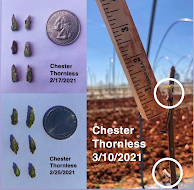
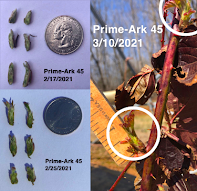
The blackberries have started to awake from their winter dormancy ahead of the raspberries. For the past few weeks we had observed  vegetative buds were  swollen and small amounts of green have started to emerge at the tips of the buds. This indicated active vegetative growth had started. Photographically recording the subtle differences in growth over time tells a better story (Fig 2). Although the buds have been swollen and showing small amounts of green, some varieties have yet to develop much beyond that point. Comparing APF-45 and Chester Thornless shows this best. 


APF-45 and Chester both had buds at a similar development stage in mid February (2/17/20), but by the following week there were some small but notable differences (2/25/21). The third visit in early March (3/10/21) clearly shows the difference between these two cultivars. Chester has a few buds with slightly more vegetative growth protruding than the previous evaluation, but many buds remain swollen with minimal green tissue visible. APF-45 has continued to develop, and a majority of buds on the top third of canes have vegetation emerging that is longer than an inch or approximately 3cm in length. Determining the date of vegetative bud break using the threshold of 3cm of protruding vegetative tissue gives a better indication of the start of active growth. 


Figure 2. Development of vegetative buds for blackberry cultivars ‘Chester Thornless’ (left) and ‘Prime-Ark 45’ (right) from mid-February to early March. Vegetative buds are circled in white. Bisected buds on 2/17 and 2/25 allow us to see internal development and check for potential frost damage, which there was none.


                  Figure 3. Data collection in NCSU plots on 2/25/21. 

Friday, January 22, 2021

NC Blackberry and Raspberry Association Zoom meetings


The NC Blackberry and Raspberry Association is holding a series of Zoom meetings this spring. The live version of the meetings are for members of the organization. However, the recorded sessions will be added to the Team Rubus Blog as well as Blackberry and Raspberry Information Portal at NCSU. 

Here are the topics and links to those talks are posted when they become available. Click on the LINK and title to load the talk in a new window.

January 21, 2021 (9-10AM): Dr. Gina Fernandez: LINK: Update on USDA/Finn Cultivar Trial and NC State Breeding Program Material & Dr. Tom Kon: LINK: Overview of Upcoming PGR Trials and Grower Input on Future Research.


February 18, 2021 (9-10AM): Wayne Mitchem: Spring Weed Management and Oryzalin Availability/Alternatives & Dr. Hannah Burrack: SWD Pruning Work and Broad Mite Update


March 18, 2021 (9-10AM): Dr. Sara Villani: 2020 Mysterious Cane Dieback Information & Elena Rogers: Caneberry Food Safety Updates


Wednesday, January 20, 2021

Pacific Northwest Small Fruit Update


FYI, the Northwest Berry Foundation produces a great newsletter that includes industry news (and more). They report on news that is focused on their industry, however, some of the topics are of interest to all small fruit growers. I encourage you to check them out at the link below. You will need to subscribe to this free newsletter, just follow the links. 

https://nwberryfoundation.org/small-fruit-update

 Here are some of the topics in the most recent newsletter:

Featured Links

Mexican blueberries gain U.S. market share (1/18, Blue Book Services)

USDA establishes weekly report to highlight seasonal & perishable product trends (1/11, Fresh Fruit Portal)

Agronometrics in Charts: Blueberry Coalition publishes analysis in response to ITC investigation (1/12, Fresh Fruit Portal)

Parasitic wasp that kills SWD discovered in Asian giant hornet trap (12/14,WSDA)

New OSU program first in nation to tackle statewide native bee inventory (1/8, Capital Press)