Showing posts with label rain. Show all posts

Monday, June 15, 2020

What causes red drupes?


Red drupe in Prime-Ark 45. Likely due to excessive rain, These drupes never turned black.


Usually all the drupelets on a ripe blackberry fruit are uniformly black. Sometimes the fruit can have drupes that are white, tan or red. White and tan drupelets have been discussed before (https://teamrubus.blogspot.com/search?q=white+drupelet). 

The focus of this post is to discuss the occurrence of red drupes in blackberry fruit. This reddening can occur after and before fruit is harvested.  There are several known causes of red drupes and some conditions that are speculation. No matter what the cause, excessive amounts of red drupes can result in rejection of fruit in wholesale markets.

After harvest
Reversion. This is the most common cause of red drupes.
Symptoms. Drupes are black at harvest and turn red after harvest.
What is known. Research conducted by Max Edgley from the University of Tasmania looked at several factors including nitrogen rates, physical damage during harvest and transportation to the cooler, air temperatures during harvest, slow or fast cooling of fruit after harvest.  

Key Findings from the University of Tasmania study:
  • Physical damage (bruising, impact and fruit compression) during harvest and shipping is the main cause of red drupelet disorder
  • High nitrogen fertigation during harvest can significantly increase the amount of fruit with red drupelet disorder post-harvest
  • Fruit core temperatures exceeding 23C (73F) at harvest significantly increase the amount of red drupelet post-harvest
  • Harvest times, techniques, and shipping conditions can be manipulated to reduce incidence of red drupelet disorder
  • A step-cooling process reducing the rate of cooling post-harvest has been effective in reducing incidence of the disorder
  • They also found that early season fruit is more prone to this disorder. 
https://www.utas.edu.au/__data/assets/pdf_file/0015/1110435/Blackberry-red-drupelet-fact-sheet-2017.pdf 

Addedum from Alejandra Salgado (PhD U Ark):  a weak cell wall can also cause reversion. 

See also blog post on red drupe reversion here: https://teamrubus.blogspot.com/search?q=white+drupelet


Before harvest
Redberry mite. (Redberry disease).
Symptoms. Fruit that are infected with Redberry mites have drupes never turn black. Red drupes are hard.
What is known. The mites inject a toxin into the base of the drupelets and as a result, the drupelets fail to develop normally.  Redberry mites are uncommon in the eastern United States. If you suspect they are the cause of red drupelets, samples should be submitted to your local plant disease and insect clinic for diagnosis.
Here is more information from:
Utah State University.

Excessive rain.
Symptoms. Red drupes are soft and never turn black.
What is known. There have been reports of significant red drupelet in parts of NC this year in fruit that are otherwise ripe and ready to harvest. Many, but not all of the fields have tunnels over them. The cultivar Prime-Ark 45 is seeing most of this disorder this season on the floricane crop. We cannot confirm that the rain is causing the red drupes, it is just our best guess at this time as the above (reversion and redberry mite) have been ruled out.

Viruses?
Red drupes have not been identified as symptoms associated with viruses to the best of our knowledge. 


Authors: Gina Fernandez, Hannah Burrack and Penny Perkins-Veazie and in consultation with multiple experts around the world. 

Tuesday, January 8, 2013

WInter Caneberry Checklist

Blackberry and Raspberry Seasonal Checklist
Winter 2012-13
Gina Fernandez, Small Fruit Specialist
North Carolina State University

This checklist was originally developed for blackberry growers in North Carolina. Many of the items apply to raspberry production as well. You may have to adjust your work activities either earlier or later depending on your location. For more detailed information, check the Southern Region Integrated Bramble Management Guide and the Southeast Regional Bramble Production Guide at: http://www.smallfruits.org/SmallFruitsRegGuide/index.htm.

Check the items off as they get done. This list is very general, but should help get you to think about what types of activities occur at various times of the year. If you would like other items to be added to this list, send them to me and I will add them next time.

WINTER
Plant growth and development
√ Plant is not visibly growing during the winter months although many blackberries will retain their leaves through the winter
√ Some differentiation is occurring in the flower buds
√ Low chilling cultivars can break bud in January after adequate winter chilling. You can monitor chilling hours accumulated in eight states in the eastern US by accessing this site: http://www.nc-climate.ncsu.edu/cronos/blackberry/index.php

Pruning and trellising
√ Pruning should occur in late winter.  However, in some areas winter ice storms can do tremendous damage to plants and trellis systems. If you produce blackberries in one of these areas, pruning can take place early winter to help avoid severe damage.
√ Make trellis repairs after plants have defoliated but before pruning and training.
Erect types
√ Prune out the spent floricanes
√ Tie canes to wires in a fan shape
√ Cut lateral branches back to 8-12”
√ Thin canes to 6-8 canes/ hill (4 ft spacing)
Trailing types
√ prune out spent floricanes
√ tie or weave canes to wire so that they do not overlap
√ prune side laterals to 12-18”
√ thin canes to 6-8 hill (6-8ft spacing)
Primocane fruiting raspberries and blackberries
√ Prune (mow) primocane fruiting types to ground level

Weed control
√ Many summer weed problems can be best managed in the fall and winter using preemergent herbicides. Determine what weeds have been or could be a problem in your area. Check with local extension agent for cultural or chemical means to control these weeds.

Insect and disease scouting
Check the Southern Regional Bramble integrated Management Guide for recommendations. www.smallfruits.org

√ To learn more about the spotted wing drosoplila and how it may impact your fruit in 2013, check out Hannah Burrack blog, she has lots of links in addition to her blog posts
√ Scout fields for insect and disease damage and remove those canes
√ Remove wild blackberries and raspberries by the roots if they are within 600 ft of your planting during the winter or treat with glyphosphate in the autumn
√ Apply liquid lime sulphur or Bordeaux for disease control before new buds are 1/8”

Planting
√ Take soil tests to determine fertility needs for spring plantings.
√ There are some new raspberry and blackberry cultivars available in 2013. If you have not tried them or it is not know how they will do in your region, it is best to order a small quantity to see how well they will perform in your area
√ For larger growers, prepare list of cultivars for 2014 plantings and order now. Smaller quantities of plants can be order in early 2013 for spring 2013 planting
√ A commercial small fruit nursery list at http://www.fruit.cornell.edu/berry/nurseries/

Water management
√ Make repairs to irrigation system (check pumps, lines, etc)
√ Plants generally do not need supplemental water in winter

Marketing and miscellaneous
√ Order containers for next season
√ Make contacts for selling fruit next season
√ Attend grower meetings:
o The 2013 North American Raspberry & Blackberry Conference Meeting
√ January 27-30, 2013 in Portland OR. http://www.raspberryblackberry.com/local.cfm?doc=webdocs%2FNorthAmericanBerryConference2013.htm
o 2013 SE Regional Fruit and Vegetable Conference
√ Jan 10-13, Savannah GA
http://www.seregionalconference.com/
o The North Carolina Commercial Blackberry and Raspberry Growers Association
√ Feb 19, 2013.  Shelby NC. For more information contact Daniel_Shires@ncsu.edu or Josh Beam <josh.beam@dole.com>

NOTE: NC Cooperative Extension will be taking over the Blackberry and Raspberry Information Portal in early 2013. The site will have essentially the same material, but a new look. Links will be provided from the old site to the new site.

***This information (originally written by me) also appears in the latest SRSFC newsletter******

Friday, September 14, 2012

National Weather Service has lots of data for your area

Earlier this week, I met with several folks from the National Weather Service at their offices in Raleigh. They wanted to know how growers across the state react to forecasts of frost and freeze, and how the NWS could improve its general services. In the process, we uncovered a useful tool that provides detailed weather information that could be very beneficial to area growers.

Using models and real time data, they are able to produce forecasts for areas in a 2.5 km area (that is about 1.5 mile). These forecasts include temperature, dew point, wind speed and direction, sky coverage (clouds), precipitation potential, relative humidity and more. You simply click on the location on a map for location and a page is generated with lots of information.

Today, after I went through the NWS Raleigh web page, I was interested in finding out what the wind speed, rain potential and low temperatures are expected this Saturday Sept 16 at 6 PM at the Carter-Finley Stadium in Raleigh (where NCSU is playing South Alabama).

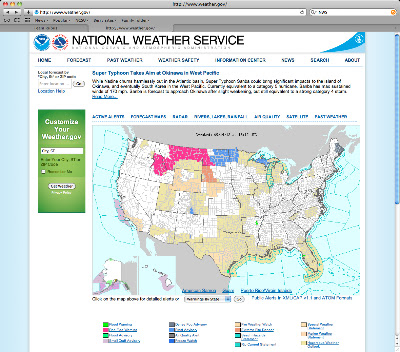
First I went to http://www.weather.gov/ and saw the page below: I clicked on central NC...


Then I clicked on the dot near Raleigh:


And this screen appeared :


Then in the above page, just off the screen above on the bottom right corner, there was a box titled "Hourly Weather Graph" I clicked on it and saw:


Viola! Looks like it will be 79 F at kick off, then cool off once the sun goes down (the image is fuzzy here, but is clear on the original site). The winds will be from the NE at 6 mph, very low chance of rain. So, it sounds like a very nice evening for a football game.

The folks at the NWS say that they are fairly confident with forecasts 6 hours from the current time. Also, in the western parts of the state of NC, there will be more variability in the accuracy of the forecasts for a particular site.

Now think how this may be of use in the spring when your buds are breaking and you need to know if there may be damage in the upcoming nights.  Will you have time to implement some type of protection for your crop? How much wind is expected, how fast will those temperature drop? Will there be cloud cover? They update this information every 3-4 hours, 24 hours a day.

We will be using this site to help us determine if we should lay down our trellises and put on row covers in our blackberry trials at the Piedmont Research Station. See earlier post on that trial: http://teamrubus.blogspot.com/2012/05/rotating-cross-arm-trellis.html


Friday, September 7, 2012

Spotted wing drosophila caught dead in its tracks

Ripe red raspberry with dead SWD stuck in the fruit.

This time of year is usually my favorite time to go to our research plots in the mountains. The temperatures are cooler, the humidity is dropping, and the fall-fruiting raspberries and blackberries are ripe.  It is usually great fun to evaluate and taste our advanced material that is in replicated trials in and out of tunnels. Well, this year, it is not that way. We are getting a double whammy this week, it rained 1.6" in 4 days, was very foggy in between rains so fruit was very soggy, even under the tunnels. AND to add a bit more misery to the soggy berry harvest, our current nemesis the Spotted wing drosophila (SWD) was present in all plots with a vengeance. In the photo above, a dead adult was stuck in a ripe fruit. YUK!

We are hopeful that the weather improves so that the rains and fog will not hamper our fruit production next week. SWD on the other hand, is a longer term problem. Fortunately we have a very dynamic researcher working on this insect, Hannah Burrack. For more on Dr. Hannah Burrack's work on SWD, check out her blog. http://ncsmallfruitsipm.blogspot.com/p/spotted-wing-drosophila-general.html

Wednesday, May 30, 2012

White (grey or tan) drupelets


In the last few days I have had several calls and emails from growers concerned about white drupelets. Here are a few points that I have gleaned from experience and other articles (see links at the end of the post).
  • It is thought that this condition is caused by UV radiation and appears when there has been an sudden increase in temperatures.
  • Rainfall appears to make the problem worse, with sunlight on wet berries plus high temperatures. (We have had quite a bit rain in parts of NC lately).
  • This was thought to be a result of stinkbug damage many years ago. BUT not now.
  • Apache shows more of this problem than any other variety, but white drupelets have been seen on most of the Arkansas varieties. 
  • Tolerance for white drupelet varies to some extent by grower. Growers that ship berries have no tolerance, while pick-your-own growers can tolerate a few white drupelets (see last point, educate your clientele).
  • White drupelet disorder is usually a problem early in the season and then disappears.
  • The berries are still edible, they make delicious pies, juice, ice cream...

For more information see

http://plantpathology.uark.edu/Number_15-2010.pdf

and

http://www.raspberryblackberry.com/Webdocs/nabga08-06news.pdf

Friday, September 9, 2011

Flooded berry fields

This article is provided courtesy of Cornell University. Although it was written for flooding situations in the northeast, some information may be useful for parts of NC as well.


DEALING WITH FLOODED BERRY FIELDS
Steve Reiners and Marvin Pritts
Dept. of Horticulture
Cornell University

Record-breaking rains in the East have left many berry growers with unmarketable crops.  What had been shaping up to be a decent season for fall raspberries and dayneutral strawberries has quickly turned into a bad situation. 

FLOODS AND FOOD SAFETY


There are two types of flooding.  The first is more typical and occurs after a heavy downpour when fields become saturated and water pools on the soil surface.  This type of flooding can reduce yields and even kill plants but usually will not result in contamination of produce with human pathogens.  The second type of flooding is more severe and unfortunately occurred with the recent storm. This occurs due to runoff from stream/river overflows will more likely be contaminated with human pathogens, as well as chemicals. Unless you are absolutely sure that flooding is not from streams and surface water, do not use berries that were covered with flood water.


PLANT SURVIVAL UNDER WATER


How long a crop can live once it is flooded and what may be the effect on yield? Berry crops can tolerate a great deal of flooding when they are dormant, but when actively growing in summer, flooding for any length of time can be detrimental. This time of year is particularly bad because plants are preparing to make flower buds for next year, and stress can compromise this process. If plant roots were under water for more than 48 hours, expect next year’s crop to be compromised as well.

Plants previously flooded may develop an off-green or yellowish color.  These plants are suffering from a complex of nutrient deficiencies, nitrogen, phosphorus, potassium and perhaps others, even though the soil contains adequate amounts. But the main deficient element is oxygen. Plant roots need oxygen to take up nutrients and water to utilize the photosynthate from the tops and to grow. With the heavy rains we have had, soils are saturated; that is, nearly all of the pore space is filled with water, leaving little room for air. Ideally, for good root growth 50 percent of the pore space should be filled with air. As soils drain, air is drawn into the soil, but when it rains, the water forces the air out of the pores. As is obvious to all, what is needed now is several rain-free days so the soils can drain and draw in air to stimulate root growth and help disperse toxic compounds that accumulate when plants lack oxygen.  Once the plant roots get adequate oxygen they will begin to grow and take up the nutrients present in the soil. Anything that can be done to remove surface water will be helpful.

Many plant diseases will be much worse following flooding rains (e.g. Phytophthora and Botrytis), so closely monitor crops and manage these diseases. Phytophthora spores are spread under flooded conditions, so chemical treatment may be warranted in susceptible crops (e.g. red raspberries and strawberries).

(Thanks to Steve Rieners and Marvin Pritts at Cornell University for sharing this with us.) 


Thursday, August 25, 2011

Hurricane Preparation

Just a quick note to caneberry growers in Eastern NC. #HurricaneIrene looks be be heading for NC. The Nursery folks at NCSU have prepared a nice list of things to do before and after a hurricane. Not all of the items will be appropriate for your situation, but many will. Here is a link.

http://www.ces.ncsu.edu/depts/hort/nursery/cultural/cultural_docs/env_effects/hurricane.html