Wednesday, December 9, 2020

Winter Caneberry Checklist


Winter Caneberry Checklist 2020-21

This checklist was originally developed for blackberry growers in North Carolina. You may have to adjust your work activities either earlier or later depending on your location. For more detailed information, check the Southern Region Integrated Bramble Management Guide and the Southeast Regional Bramble Production Guide at: Link to SRSFC Caneberry IPM and Production Guides.


This list is intended as a general guide. However, it can be used to guide you to think about what types of activities occur at various times of the year. Check the items off as they get done. If you would like other items to be added to this list, send them to me and I will add them next time.


WINTER 

Plant growth and development

  • Plant is not visibly growing during the winter months although many blackberries will retain their leaves through the winter
  • Some floral differentiation is occurring in the flower buds (i.e. they are forming flowers)
  • Low chilling cultivars can break bud in January after adequate winter chilling. You can monitor chilling hours accumulated in eight states in the eastern US by accessing this site: Link to Blackberry Chill Model

Developmental stages at this time of year as mentioned in the 2021 Southeast Regional Caneberries Integrated Management Guide are : 1. Dormant 2. Delayed dormant (swollen bud) to green tip.


Pruning and trellising

  • Pruning should occur in late winter. However, in some areas winter ice storms can do tremendous damage to plants and trellis systems. If you produce blackberries in one of these areas, pruning can take place early winter to help avoid severe damage.
  • Pruning and training videos can be found at:
  • Make trellis repairs after plants have defoliated but before pruning and training.
  • If you have a Rotating Arm Trellis, lay the canes to the ground. If you are in a colder region, have row covers available for protection from cold temperatures.
    • Erect types
      • Prune out the spent floricanes
      • Cut lateral branches back to 12-18”
      • Tie or weave canes to lower and upper wires
      • Thin canes to 4-8 canes/ hill (4 ft spacing)
    • Trailing types
      • Prune out spent floricanes
      • Tie or weave canes to wire so that they do not overlap
      • Prune side laterals to 12-18”
      • Thin canes to 6-8 hill (6-8 ft spacing)
    • Primocane fruiting raspberries and blackberries
      • Prune (mow) primocane fruiting types to ground level


    Weed control

    Check the 2021 Southeast Regional Caneberries Integrated Management Guide

    for recommendations.

    • Many summer weed problems can be best managed in the fall and winter using preemergent herbicides. Determine what weeds have been or could be a problem in your area. Check with local extension agent for cultural or chemical means to control these weeds. 

    Insect and disease scouting

    Check the 2021 Southeast Regional Caneberries Integrated Management Guide

     for recommendations.

    ·      Scout fields for insect and disease damage and remove those canes

    • Remove wild blackberries and raspberries by the roots if they are within 600 ft of your planting during the winter 

    Winter injury from cold

    ·      Injury from cold temperatures can occur to the canes and buds throughout the winter. Most often the damage occurs in the spring after the winter chilling hours have accumulated.

    ·      Review types of injury that can occur to the canes and buds. One site for cold injury information is the Team Rubus Blog.


    Planting

    • Take soil tests to determine fertility needs for spring plantings. 
    • There are new raspberry and blackberry cultivars available each year. If you have not tried them or it is not known how they will do in your region, it is best to order a small quantity to see how well they will perform in your area
    • For larger growers, prepare list of cultivars for 2022 plantings and order now. Smaller quantities of plants can be ordered in early 2021 for spring planting.
    • Nursery lists can be found at:


    Water management

    • Make repairs to irrigation system (check pumps, lines, etc)
    • Plants generally do not need supplemental water in winter 


    Marketing and miscellaneous

    • Order containers for next season
    • Make contacts for selling fruit next season


    For more detailed information, check the Southern Region Integrated Caneberry Management Guide and the Southeast Regional Bramble Production Guide online version: https://content.ces.ncsu.edu/southeast-regional-caneberry-production-guide

    Or PDF version: https://content.ces.ncsu.edu/show_ep3_pdf/1607523686/22996/


    Attend grower meetings

    North American Raspberry and Blackberry Association (virtual meeting in 2021)

    https://www.raspberryblackberry.com/


    SE Regional Fruit and Vegetable  Conference (Savannah meeting is virtual in 2021)

    https://seregionalconference.org/


    Thursday, December 3, 2020

    Blackberry V-Trellis Construction


    Blackberry V-Trellis Construction


    This short step-by-step guide is to help new growers build a V-trellis for growing blackberries. The supplies needed and the steps to build the trellis are included. This guide was developed by a tlaented group from NC Cooperative Extension (Nancy Power and Paige Burns), Sandhills Research Station (Jermy Martin) and the Sandhills AgInnovatoin Center (David Goodwin). Their contact information is at the end of this blog post.


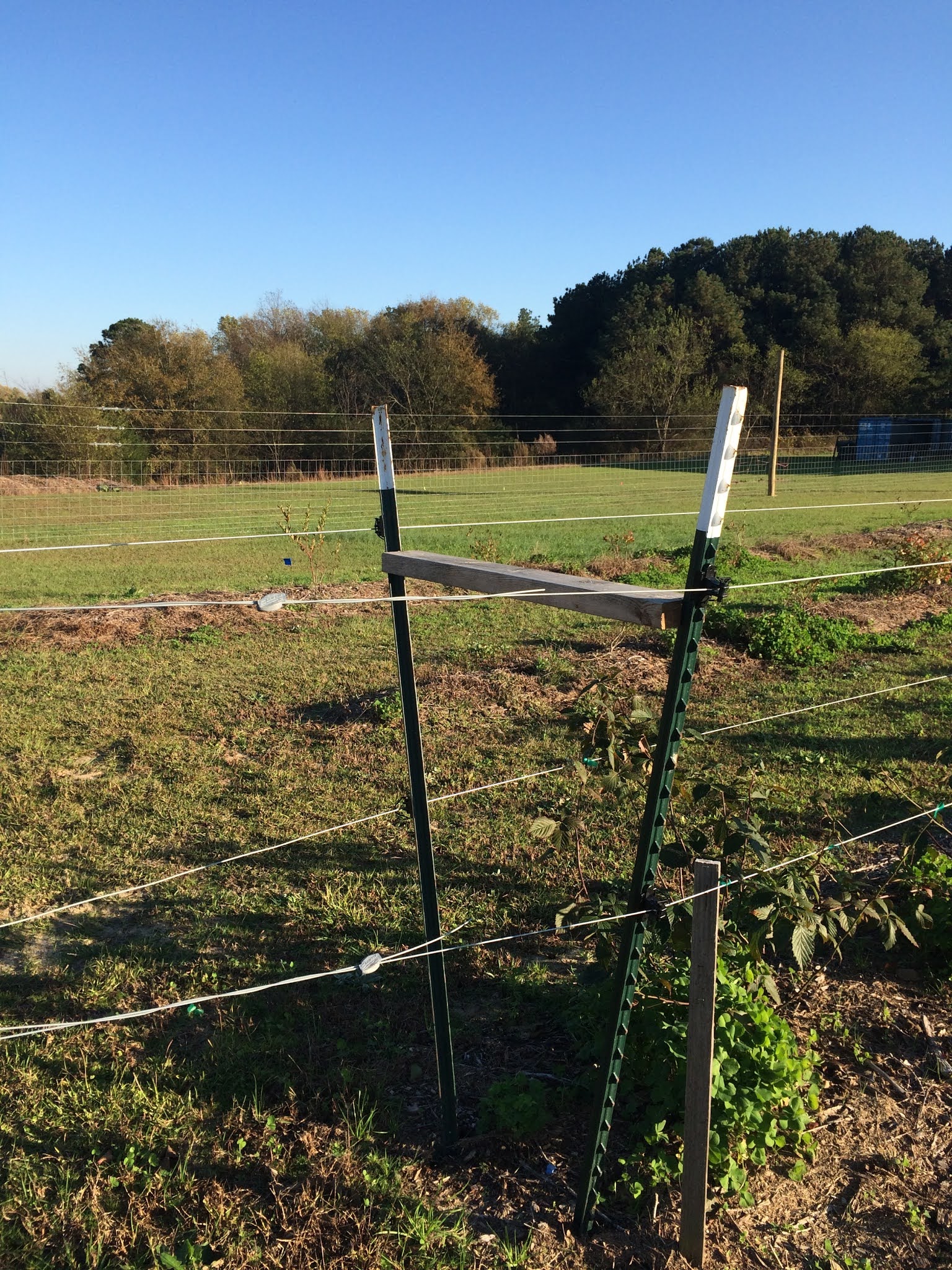
    Figure 1. Blackberry V-trellis with 30" board to keep T-posts separate.


    Supplies:

    Item(s)

    unit cost ($)

    cost per 100’ row (rounded to nearest $)

    two 8’ round, wooden end posts, 4” diameter

    10

      10

    eight 6’ steel T-posts*

      5

      40

    400+ feet 12-gauge galvanized wire

    $105/1000 ft

      11

    two 2 x 4 boards, 23-30” long

    $10/10 ft

        4

    16 T-post pin-lock insulators

    $10/bag of 25

        7

    2 gripples

    $31/pack of 20

        3

    floral tape

      2

        2

    4 galvanized barbed staples or poultry staples

    $4/bag of 52

        0

    total cost per 100’ row


    $72


    Tools:

    -       100’ or longer measuring tape

    -       spinning jenny

    -       gripple tightening tool

    -       pliers

    -       post pounder

    -       tapener

    -       watering can or water bottle or hose

    -       shovel

    -       hammer or mallet

    *If row is 100’ or less, T-posts can be up to 35’ apart in the row; if row is >100’, 25’ apart is the recommended maximum.


    Procedures:

    Wear safety glasses, especially for hammering the posts and working with the wire.

    1.     End post (Figure 2).

    a.     At each end of the row, insert an end post into ground about 6’ from the end berry plant by one of the following methods:

                                                   i.     Pound post in with a pile driver

                                                 ii.     Dig or auger hole 3’ deep

    b.     Insert post and have one person hold it upright

    c.     Add a little soil to the hole

    d.     Pound soil in hole with the handle end of a shovel

    e.     Add a little water

    f.      Repeat the above three steps until the hole is full and packed in tightly (about four rounds).


    Figure 2. Metal T-post brace hammered into wooden 8' end post.

    2.     Row posts (Figure 3).

    a.     Using measuring tape, lay T-posts out at 25-35’ intervals, starting at 2’ beyond the end plants (4’ in from end posts).  If the row is 100’ or shorter, the spacing can be up to 35’.  If the row is longer than 100’, a 25’ spacing between posts is recommended.

    b.     Set up a brace post (Figure 2):

                                                   i.     Insert a T-post in the ground about 16” in from the end post, with the base of the T facing the end post, angled so that it the T-post extends past the end post.

                                                 ii.     Pound the T-post into the ground at an angle until the top is next to the end post.

                                               iii.     Push the top of the T-post so that it is inside the end post.

                                                iv.     Use the side of the post pounder or a mallet to pound the T edge into the wood.

                                                 v.     Repeat for the other end post brace.

    c.     Use the post pounder to insert the other T-posts 25-35 feet apart, in pairs, at a 20-30°  angle so that each pair makes a “V.” (See Figure 16a in Southeast Regional Caneberry Production Guide)

    d.     Use pliers to attach 2 insulators on the outside of each T-post, one at the 5th notch down on the post, and one at the 16th notch (roughly at 4’ and a man’s knee height), with the pin at the top.  Put the pin in the hole of each insulator.

    e.     Turn the L-shaped rods inward on the spinning jenny and add a roll of 12-gauge fence wire.  Turn the L-rods back outward over the wire.

    f.      Pull on one end of the wire to wrap the wire around the outside of the end posts and T-posts at knee level, threading the wire through the insulators as you go.

    g.     Where the ends of wire meet, thread each end through the gripple, allowing for “tails” on both ends of the wire.

    h.     Use the gripple tool to ratchet the wire fairly tightly, but not as tightly as possible.  After the posts set (in a few weeks), the wires can be tightened further. 

    i.      Insert a 2x4 horizontally between the T-post pair at each end of the row.  Push the board down till it fits tightly between the T-posts (Figure 1).  You may want to size and cut the board after the rest of the trellis is assembled, to make sure it fits.

    j.      At the outside end of each end post, hammer a staple in far enough to hold the wire in place vertically but to allow the wire to move horizontally for tightening. 


    Figure 3. Pow posts: 6' metal T-posts with 12-guage wire running through black plastic insulators facing outward.

    If desired, the lower wires can support ¼” irrigation hose.


    This construction guide was repared by:

    Jeremy Martin, Research Operations Manager, Sandhills Research Station, 910-974-4673.

    Nancy Power, Commercial Horticulture Agent, NC Cooperative Extension, Richmond County Center, 910-997-8255.

    Davon Goodwin, Manager, Sandhills AgInnovation Center, 910-992-8176.

    Paige Burns, County Extension Director, NC Cooperative Extension, Richmond County Center, 910-997-8255.


    Reference:

    Fernandez, G.E., E. Garcia, D. Lockwood. 2016. Southeast Caneberry Production Guide. AG-697. https://content.ces.ncsu.edu/show_ep3_pdf/1604932460/22996/


    Friday, October 9, 2020

    New student, new study


    Team Rubus has a new member, Katie Sheehan-Lust.  Katie is from California and got her BS degree at Cal Poly San Luis Obispo (SLO). While at Cal Poly SLO she worked at the Strawberry Center with Dr. Gerald Holmes. After graduation  she worked at Naturipe with Dr. Hillary Quinn Thomas, also working with strawberries. We are giving her a bit of switch in berry crops, she will be working on a Rubus project we have with Pairwise, Cornell, USDA-ARS Corvallis, the University of Arkansas and BC Berry Cultivar Development in Canada. 

    Katie traveled across the country to start a MS degree at NCSU, in the midst of a pandemic. We take that tenacity in the face of COVID as a good sign. Although classes are online and we don't get to see her everyday, we were able to go to the field and she jumped right into field work. Welcome Katie!

    Saturday, July 25, 2020

    Help us help you part 2!


    This is a follow up survey on our May 2020 grower survey (results are here). 
     
    Our goal is to better understand the impact of COVID-19 on specialty crop farming operations in NC as the season progresses and crops change. We are looking to survey all fruit growers, vegetable growers, flower/hemp/herb growers. 


    The survey is anonymous and will take approx. 5-8 min. The survey will be open until July 30, 2020.

    Monday, June 15, 2020

    What causes red drupes?


    Red drupe in Prime-Ark 45. Likely due to excessive rain, These drupes never turned black.


    Usually all the drupelets on a ripe blackberry fruit are uniformly black. Sometimes the fruit can have drupes that are white, tan or red. White and tan drupelets have been discussed before (https://teamrubus.blogspot.com/search?q=white+drupelet). 

    The focus of this post is to discuss the occurrence of red drupes in blackberry fruit. This reddening can occur after and before fruit is harvested.  There are several known causes of red drupes and some conditions that are speculation. No matter what the cause, excessive amounts of red drupes can result in rejection of fruit in wholesale markets.

    After harvest
    Reversion. This is the most common cause of red drupes.
    Symptoms. Drupes are black at harvest and turn red after harvest.
    What is known. Research conducted by Max Edgley from the University of Tasmania looked at several factors including nitrogen rates, physical damage during harvest and transportation to the cooler, air temperatures during harvest, slow or fast cooling of fruit after harvest.  

    Key Findings from the University of Tasmania study:
    • Physical damage (bruising, impact and fruit compression) during harvest and shipping is the main cause of red drupelet disorder
    • High nitrogen fertigation during harvest can significantly increase the amount of fruit with red drupelet disorder post-harvest
    • Fruit core temperatures exceeding 23C (73F) at harvest significantly increase the amount of red drupelet post-harvest
    • Harvest times, techniques, and shipping conditions can be manipulated to reduce incidence of red drupelet disorder
    • A step-cooling process reducing the rate of cooling post-harvest has been effective in reducing incidence of the disorder
    • They also found that early season fruit is more prone to this disorder. 
    https://www.utas.edu.au/__data/assets/pdf_file/0015/1110435/Blackberry-red-drupelet-fact-sheet-2017.pdf 

    Addedum from Alejandra Salgado (PhD U Ark):  a weak cell wall can also cause reversion. 

    See also blog post on red drupe reversion here: https://teamrubus.blogspot.com/search?q=white+drupelet


    Before harvest
    Redberry mite. (Redberry disease).
    Symptoms. Fruit that are infected with Redberry mites have drupes never turn black. Red drupes are hard.
    What is known. The mites inject a toxin into the base of the drupelets and as a result, the drupelets fail to develop normally.  Redberry mites are uncommon in the eastern United States. If you suspect they are the cause of red drupelets, samples should be submitted to your local plant disease and insect clinic for diagnosis.
    Here is more information from:
    Utah State University.

    Excessive rain.
    Symptoms. Red drupes are soft and never turn black.
    What is known. There have been reports of significant red drupelet in parts of NC this year in fruit that are otherwise ripe and ready to harvest. Many, but not all of the fields have tunnels over them. The cultivar Prime-Ark 45 is seeing most of this disorder this season on the floricane crop. We cannot confirm that the rain is causing the red drupes, it is just our best guess at this time as the above (reversion and redberry mite) have been ruled out.

    Viruses?
    Red drupes have not been identified as symptoms associated with viruses to the best of our knowledge. 


    Authors: Gina Fernandez, Hannah Burrack and Penny Perkins-Veazie and in consultation with multiple experts around the world. 

    Monday, June 8, 2020

    Caneberry survey on pricing and Covid-19 impacts

     Help us help you

    The survey closes on Monday, June 22, 2020

    The North American Raspberry and Blackberry Association (NARBA), in collaboration with NC State University and the University of Arkansas, is conducting its biennial pricing survey. Growers of caneberries (raspberries, blackberries, and hybrids) in Canada and the U.S. will be asked about prices they received across all distribution methods. This year, additional questions have been added to capture the impact of COVID-19 on caneberry prices and caneberry operations. All growers who had any caneberry acreage in 2019 or 2020 are invited to participate: TAKE THE SURVEY The results of the survey will help caneberry growers, and anyone considering growing caneberries, better plan their pricing and production decisions in future years. In addition, this data is useful to researchers and policymakers who need accurate data about caneberry pricing trends in the North American caneberry industry. Caneberry growers can participate in the online survey by following this link. Survey results will be reported in the NARBA newsletter. For more information about the survey, contact Daniel Tregeagle (tregeagle@ncsu.edu or 919-515-6091). For more information about the North American caneberry industry, contact NARBA Executive Secretary Debby Wechsler (raspberryblackberry@gmail.com or 919-542-4037).

    Link to survey here: https://covid19.ces.ncsu.edu/2020/06/2020-caneberry-survey-on-pricing-covid-19-impacts/
    2020
    The North American Raspberry and Blackberry Association (NARBA), in collaboration with NC State University and the University of Arkansas, is conducting its biennial pricing survey. Growers of caneberries (raspberries, blackberries, and hybrids) in Canada and the U.S. will be asked about prices they received across all distribution methods. This year, additional questions have been added to capture the impact of COVID-19 on caneberry prices and caneberry operations. All growers who had any caneberry acreage in 2019 or 2020 are invited to participate: TAKE THE SURVEY The results of the survey will help caneberry growers, and anyone considering growing caneberries, better plan their pricing and production decisions in future years. In addition, this data is useful to researchers and policymakers who need accurate data about caneberry pricing trends in the North American caneberry industry. Caneberry growers can participate in the online survey by following this link. Survey results will be reported in the NARBA newsletter. For more information about the survey, contact Daniel Tregeagle (tregeagle@ncsu.edu or 919-515-6091). For more information about the North American caneberry industry, contact NARBA Executive Secretary Debby Wechsler (raspberryblackberry@gmail.com or 919-542-4037).

    Read more at: https://covid19.ces.ncsu.edu/2020/06/2020-caneberry-survey-on-pricing-covid-19-impacts/
    The North American Raspberry and Blackberry Association (NARBA), in collaboration with NC State University and the University of Arkansas, is conducting its biennial pricing survey. Growers of caneberries (raspberries, blackberries, and hybrids) in Canada and the U.S. will be asked about prices they received across all distribution methods. This year, additional questions have been added to capture the impact of COVID-19 on caneberry prices and caneberry operations. All growers who had any caneberry acreage in 2019 or 2020 are invited to participate: TAKE THE SURVEY The results of the survey will help caneberry growers, and anyone considering growing caneberries, better plan their pricing and production decisions in future years. In addition, this data is useful to researchers and policymakers who need accurate data about caneberry pricing trends in the North American caneberry industry. Caneberry growers can participate in the online survey by following this link. Survey results will be reported in the NARBA newsletter. For more information about the survey, contact Daniel Tregeagle (tregeagle@ncsu.edu or 919-515-6091). For more information about the North American caneberry industry, contact NARBA Executive Secretary Debby Wechsler (raspberryblackberry@gmail.com or 919-542-4037).

    Read more at: https://covid19.ces.ncsu.edu/2020/06/2020-caneberry-survey-on-pricing-covid-19-impacts/
    The North American Raspberry and Blackberry Association (NARBA), in collaboration with NC State University and the University of Arkansas, is conducting its biennial pricing survey. Growers of caneberries (raspberries, blackberries, and hybrids) in Canada and the U.S. will be asked about prices they received across all distribution methods. This year, additional questions have been added to capture the impact of COVID-19 on caneberry prices and caneberry operations. All growers who had any caneberry acreage in 2019 or 2020 are invited to participate: TAKE THE SURVEY The results of the survey will help caneberry growers, and anyone considering growing caneberries, better plan their pricing and production decisions in future years. In addition, this data is useful to researchers and policymakers who need accurate data about caneberry pricing trends in the North American caneberry industry. Caneberry growers can participate in the online survey by following this link. Survey results will be reported in the NARBA newsletter. For more information about the survey, contact Daniel Tregeagle (tregeagle@ncsu.edu or 919-515-6091). For more information about the North American caneberry industry, contact NARBA Executive Secretary Debby Wechsler (raspberryblackberry@gmail.com or 919-542-4037).

    Read more at: https://covid19.ces.ncsu.edu/2020/06/2020-caneberry-survey-on-pricing-covid-19-impacts/