
Monday, June 10, 2019


Tuesday, March 26, 2019
Tour of eastern NC blackberry industry
 |
| Picture of people at one of the new blackberry farms in Bladen Co. |
Last week our lab group took a tour of the growing blackberry industry in eastern NC with the local county agent in Bladen Co, Bruce Mclean (thanks Bruce). We were joined by staff from the Piedmont Research Station, Hort Crop Unit.
Although blackberries are not new to this part of the state, this new acreage is an exciting addition to our dynamic blackberry industry. Here are a few of the highlights...
- There are several new large plantings of 20 acres or more in the area and all will be under high tunnels when in fruit is being produced.


- Growers are using automated fertigation systems that can be run from cell phones remotely.

- Some growers are planting Univ. of Arkansas cultivars including the new 'Caddo', one grower is testing some of the new USDA cultivars ('Eclipse' and 'Galaxy') others are planting proprietary cultivars.


Monday, March 18, 2019
Spring Caneberry Checklist 2019
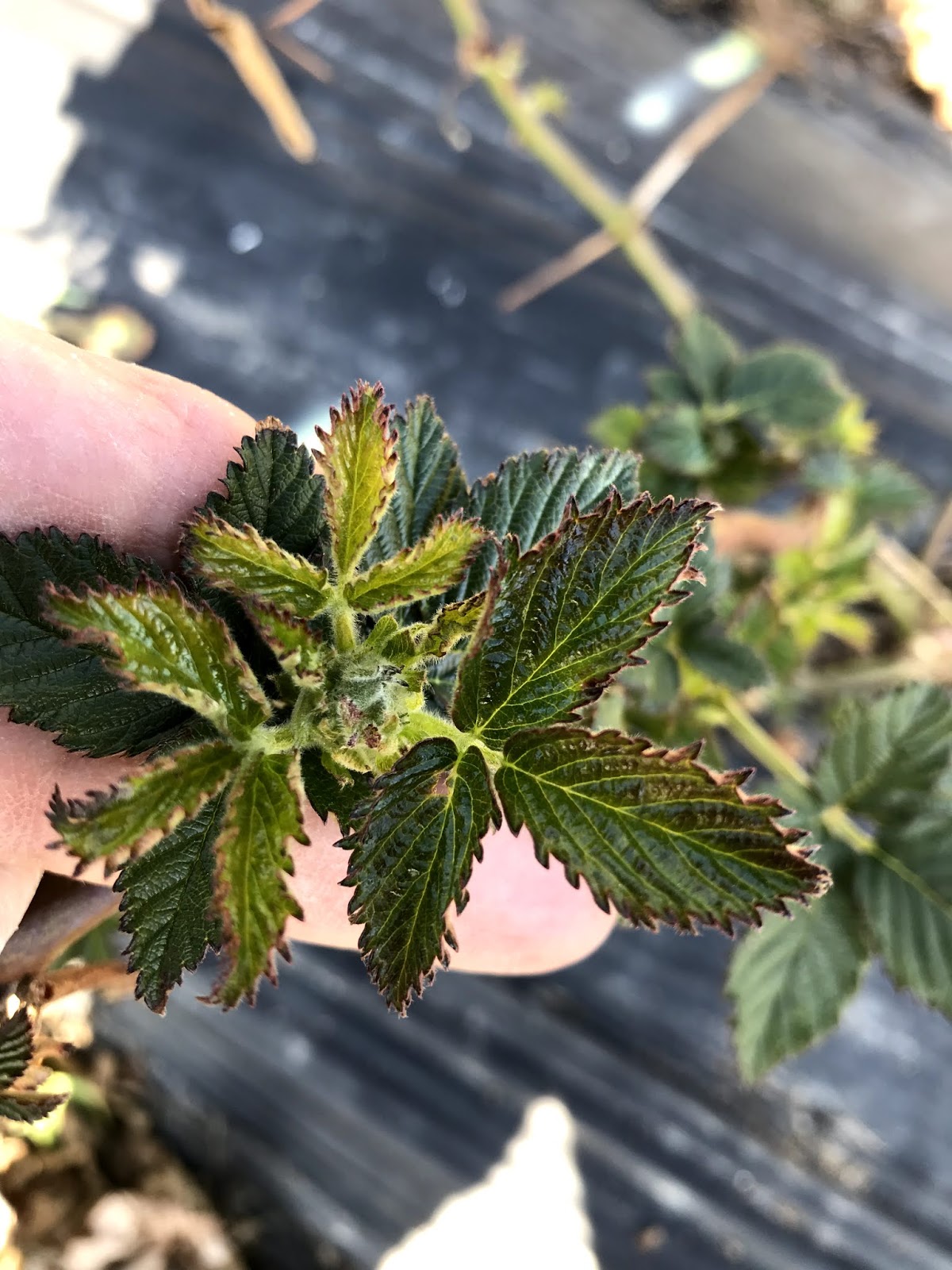
Spring 2019 has been WET. But blackberry plants have broken
bud are ready to start the season throughout the regoin. Chores and timing may
be somewhat different in your area or for your cropping system.
For IPM recommendations and general production practices,
see the 2019 Southeast Regional Caneberry Integrated Management Guide.
The SRSFC production practices are in the Regional Caneberry
Production guide (includes link to PDF format):
·
https://content.ces.ncsu.edu/southeast-regional-caneberry-production-guide
Crop phenology for IPM
The IPM
guide above lists these stages of growth or planting age. This is the time of
year we are now leaving (or have left a while ago!) the dormant period and by
the time the next newsletter comes out, we will likely be harvesting in some
locations.
·
Dormant (prior to budbreak)
·
Delayed dormant (swollen buds) to green tip
·
Shoots 6 inches long and before blooms open
·
Pre-bloom (when flower buds show white)
·
Early bloom (5-10%)
·
Full Petal
·
Cover sprays
·
Pre-harvest (14 days before anticipated harvest)
·
Harvest
Plant growth and
development during the spring/summer
·
Plants deacclimate quickly
·
Bud differentiation (additional flowers can be formed)
·
Bud break
·
Flowering
·
Primocane emergence
Pruning and trellising
·
Finish pruning and make sure all floricanes are
tied to the trellis before budbreak
·
Remove canes from field to minimize spread of
diseases
·
Rotate shift trellises to horizontal position
before budbreak; rotate to upright position immediately after flowering.
·
Prepare for flower to fruit monitoring (see http://teamrubus.blogspot.com/2015/03/monitoring-flower-to-fruit-development.html
)
Weeds
·
Weed growth can be very vigorous at the same time
as the bramble crop peaks
·
Weed control is best done earlier in the season,
with pre-emergent herbicides before harvest commences
·
Hand-weed perennial weeds in and around plots
Insect, disease and
crop ripening
·
Growers with a history of cane diseases and/or
mites often find that certain fungicides and oils are most effective just prior
to bud break. The period of time in the spring when the plant is flowering is
the most important season for control of insects and diseases. Know what your
pests are and how to control them.
Water management
·
Test irrigation system and look for leaks
·
Caneberry plants need about 1”-2” water/week.
This amount will be especially critical during harvest
Fertility management See
Caneberry Production Guide
Marketing and miscellaneous
·
Service and clean coolers
·
Make sure you have enough containers for fruit
in the coming season
·
Prepare advertising and signage for your stand
·
Contact buyers to finalize orders
·
Hire pickers
·
Prepare signage for field orientation; it is
easier to tell pickers where to go if rows are numbered
·
Check buds and canes for cold damage (27°F
is temperature that kills all stages of flower buds see http://teamrubus.blogspot.com/2016/04/damgage-to-blackberry-flowers-at-27f.html
·
Monitor and record peak flowering date for each
variety every year. Then later during harvest, check your records for peak
harvest of each variety. Over time, it
will help you to determine when your peak harvest will occur.
Sunday, February 3, 2019
WInter Caneberry Checklist
This checklist was
originally developed for blackberry growers in North Carolina. Many of the
items apply to raspberry production as well. You may have to adjust your work
activities either earlier or later depending on your location.
This checklist is very
general, but should help get you to think about what types of activities occur
at various times of the year.
Check the items listed
below off as they get done.
WINTER
Plant growth and
development
·
Plant is not visibly
growing during the winter months although many blackberries will retain their
leaves through the winter
·
Some differentiation
occurs in the flower buds (flowers continue to develop)
·
Low chilling cultivars
can break bud in January after adequate winter chilling. You can monitor
chilling hours accumulated in eight states in the eastern US by accessing this
site: cronos/blackberry/chill_model
·
Developmental stages
at this time of year as mentioned in the IPM guide http://www.smallfruits.org/assets/documents/ipm-guides/Caneberry-Spray-Guide.pdf
are : 1. Dormant 2.Delayed
dormant (swollen bud) to green tip
Pruning and trellising
·
Pruning should occur
in late winter. However, in some areas winter ice storms can do
tremendous damage to plants and trellis systems. If you produce blackberries in
one of these areas, pruning can take place early winter to help avoid severe
damage
·
Make trellis repairs
after plants have defoliated but before pruning and training.
·
Erect types
- Prune out the spent floricanes
- Tie canes to wires in a fan shape
- Cut lateral branches back to 8-12”
- Thin canes to 6-8 canes/ hill (4 ft spacing)
·
Trailing types
- Prune out spent floricanes
- Tie or weave canes to wire so that they do not overlap
- Prune side laterals to 12-18”
- Thin canes to 6-8 hill (6-8 ft spacing)
·
Primocane fruiting
raspberries and blackberries
- Prune (mow) primocane fruiting types to ground level
Weed control
Check the Southern
Regional Bramble Integrated Management Guide for recommendations.
www.smallfruits.org
·
Many summer weed
problems can be best managed in the fall and winter using preemergent
herbicides. Determine what weeds have been or could be a problem in your area.
Check with local extension agent for cultural or chemical means to control
these weeds.
·
Some growers are
having success with biodegradable mulch to suppress the weeds the year of the
planting
Insect and disease scouting
Check the Southern
Regional Bramble Integrated Management Guide for recommendations.
www.smallfruits.org
·
Scout fields for
insect and disease damage and remove those canes
·
Remove wild
blackberries and raspberries by the roots if they are within 600 ft of your
planting during the winter
Planting
·
Take soil tests to
determine fertility needs for spring plantings.
·
There are some new
raspberry and blackberry cultivars available each year. If you have not tried
them or it is not know how they will do in your region, it is best to order a
small quantity to see how well they will perform in your area
·
For larger growers, prepare
list of cultivars for 2020 plantings and order now. Smaller quantities of
plants can be order in early 2019 for spring 2020 planting
·
A commercial small
fruit nursery lists at
- www.raspberryblackberry.com/ for-growers/
- https:// blogs.cornell.edu/berrynurseries/
Water management
·
Make repairs to
irrigation system (check pumps, lines, etc.)
·
Plants generally do
not need supplemental water in winter
Marketing and
miscellaneous
·
Order containers for
next season
·
Make contacts for
selling fruit next season
For more detailed
information, check the Southern Region Integrated Bramble Management Guide and
the Southeast Regional Bramble Production Guide online version: https://content.ces.ncsu.edu/southeast-regional-caneberry-production-guide
Or PDF version: http://www.smallfruits.org/assets/documents/ipm-guides/2016/AG-697_2016SoutheasternCaneberryProduction_Press.pdf
Attend grower meetings
North Carolina
Commercial Blackberry and Raspberry Association. Feb 15, 2019.
Meeting will be held
at the Cleveland County Extension Auditorium, 130 S. Post Rd; Shelby, NC 28152.
Please arrive in time to set up prior to the start of the meeting. Contact
Daniel Shires for more information. (704) 482-4365
Subscribe to:
Posts (Atom)