Saturday, April 18, 2020

Blackberry crop damage spring 2020


Over the last week there have been cool temperatures at night that have damaged the blackberry crop. The crop in some areas was 10 days to 2 weeks earlier than usual. This year we saw damage to the primocanes, something that we have not seen before. Thanks to the many growers I have talked to over the past couple of days for sending in the pictures below.  My impression is that the site and not cultivar has more to do with damage. Higher sites on the same farm incurred less damage. Also healthier plants sustained less damage.

Flower bud damage
The first image below are from a field visit a few years ago. The first image illustrates how a fruiting lateral looks fine on the outside, however once you slice open that same shoot, you can see that many of the centers (technically receptacles) of the flower buds are black. If the centers of the buds are black, they will not develop into fruit. If they are green, the fruit will develop normally.


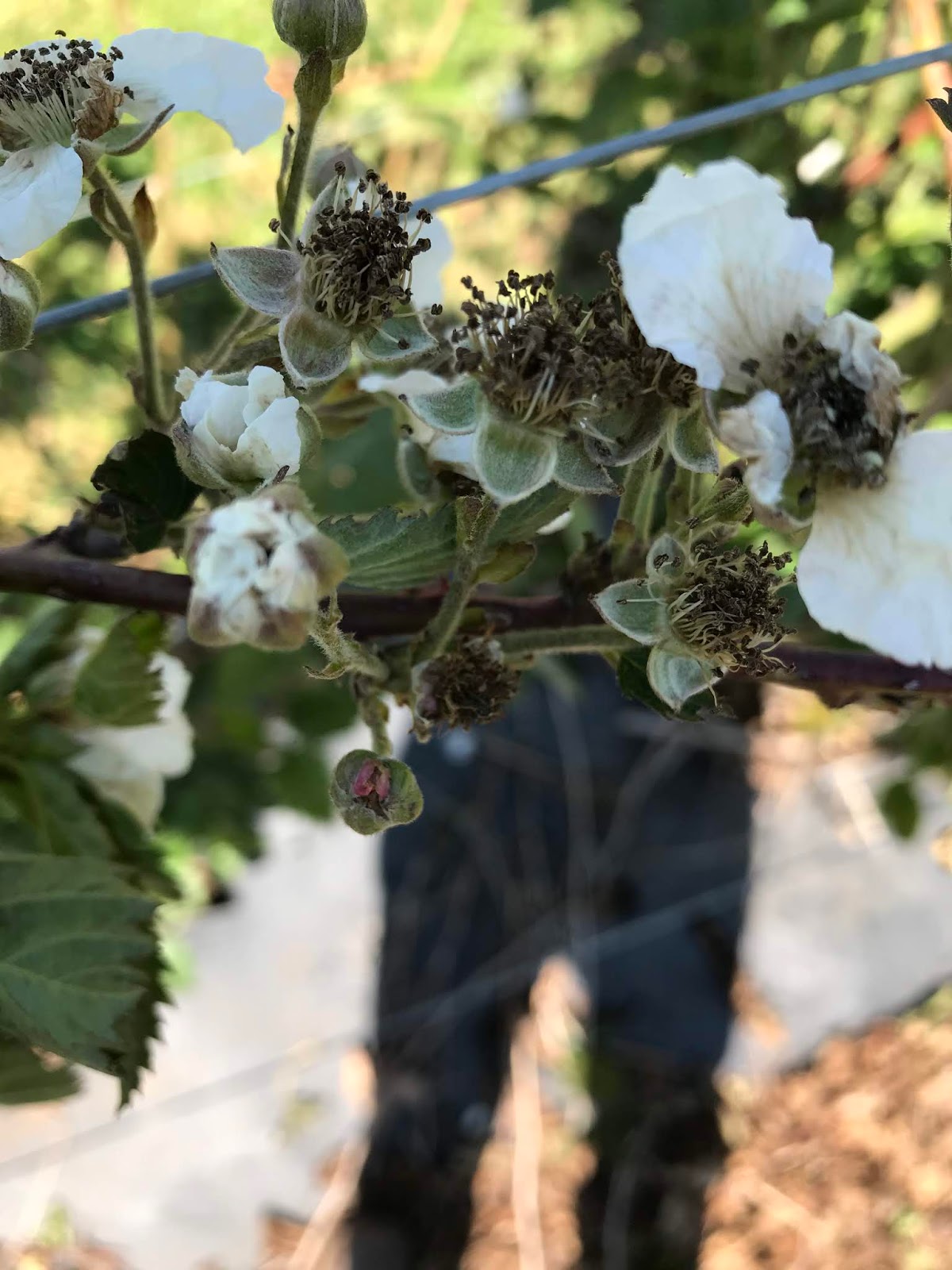
On most farms, the crop this year was further along and the damage is easier to spot, no need to cut open the buds. The blackened centers are the receptacles. Culitvars from top to bottom are: Prime-Ark 45, Natchez, Osage and Freedom.
Prime-Ark 45
Natchez

Osage

Floricane crop of Freedom. Date is not correct.

Damage to primocanes
This year we saw damage to the newly emerged primocanes.  We think that the winds that came through over the last week made the plants more vulnerable to the cold temperatures. The damaged tissue will die. However, there are still buds on the lower canes and they will emerge and start growing. The response of the plant will be similar to tipping. 

Traveler cane damage.

Traveler tip damage
Freedom tip damage.
Freedom leaf damage.


What to do this year?
  • Wait a few days to determine the extent of the damage. Some areas in the region may sustain further damage this weekend and early next week.
  • Secondary buds near the base of the primary shoots may start to grow into a secondary shoot. Here is a link to secondary bud information on this blog. The secondary buds/shoots are often very fruitful, and will produce a later crop. https://teamrubus.blogspot.com/search?q=secondary+buds
  • When damage was severe, prune out the entire canes, removing all the dead flowers and the canes that they are attached to. 
  • In all cases, maintain a fungicide program, the dead primocane and floral bud tissue in the field will be susceptible to additional disease infection.  
What to think about for the future? 
Thanks to the many growers and to Karen Blaedow, NCCES Henderson County agent who shared their images with me.


Monday, April 13, 2020

Assessing cold damage of your blackberry crop

This past weekend, parts of NC dropped below the freezing point. You should be scouting your blackberry fields, especially low spots to determine if damage occurred. Look for black/brown centers in the flower buds.  To look for damage use your fingernail or a small knife to slice open flower buds. You can do it either lengthwise or horizontally.


We know that damage to the female portion of the flower bud occurs when the internal bud temperature is 27°F. Unlike strawberry, the floral buds are equally sensitive at all stages of bud development. (Data courtesy Fumi Takeda USDA)


 For lots more information on flower bud damage here is a link:
 https://teamrubus.blogspot.com/search?q=cold+damage

Friday, April 10, 2020

Monday, March 30, 2020

Cleaning, Sanitizing, and Disinfection Workshop for Direct Market Growers

 
Blackberry and raspberry growers (primarily small farm markets):
 
The NCSU Produce Safety Team has put together a workshop to talk about the issues around cleaning, sanitizing, and disinfection for produce growers and to answer questions you may be having on these issues.

On Friday April 3rd, NCSU will host a session for small growers from 8:30-9:30am.  

All you have to do is click on the link below at the designated time and date:
ncsu.zoom.us/j/657786292 - Grower Training April 3rd, 8:30am

Friday, March 27, 2020

More COVID-19 information

The NC Cooperative Extension Service has developed a lot of resources for growers related to the COVID-19 pandemic, including information for Farms and Agribusiness, Food Safety and more.

The comprehensive site is here:
https://covid19.ces.ncsu.edu

Includes:
Is Coronavirus an issue in  Produce Production?

https://foodsafety.ces.ncsu.edu/wp-content/uploads/2020/03/ProduceProduction_Food-Safety_COVID-19_Flyer_032020.pdf?fwd=no


And a link to Farming Resources developed by Mark Hoffmann (Strawberry and Grape Extension Specialist)

https://strawberries.ces.ncsu.edu/2020/03/covid-19-farming-resources/

Tuesday, March 17, 2020

FAQ: Covid 19 for U Pick and Farmers Markets

NCSU has prepared FAQ infosheets for U Pick and Farmers Markets.
  
"THE GOOD NEWS COVID-19 is not a foodborne illness. It is extremely unlikely that someone will catch it through eating. The virus is most likely to cause illness through respiratory transmission, not eating. The routes to be concerned about include being in very close proximity to many people or coming in contact with high touch surfaces." (Quote from infosheets below)

Links with other information specific to U Pick and Farmers Markets:


Additional Resources can be found at:

Thursday, February 27, 2020

Blackberries buds vulerable to cold

Temperatures early Sunday morning may be low in blackberry fields in western NC. Remember that the killing temperature for a blackberry bud is 27-28F.  Check your buds Sunday afternoon or Monday. Damage will look like this. The darkened center of the bud shows that the receptacle has been damaged and no fruit will develop from the bud. The smaller bud on the right, has no darkened center and it will produce fruit.