Showing posts with label diseases. Show all posts

Monday, April 22, 2013

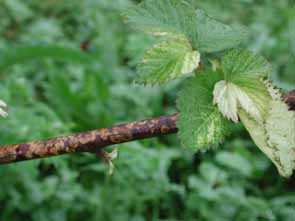
Orange spots on canes? It could be Orange Cane Blotch AKA Orange Felt

Orange Cane Blotch. Picture Gina Fernandez.
Orange Felt or Orange Cane Blotch (Cephaleuros virescens) is a problem that occurs on blackberry canes in the warmer regions of NC. The "disease" is actually a parasitic algae.  It is usually first seen on the floricanes in the spring as yellow/orange disks. Plants with higher infection rates can have the disk shapes join into larger regions on the canes. In mid summer they can become velvety in appearance. Severe infections should be controlled as they will significantly weaken the plants.

I first saw this about 10 years ago in southeastern NC, before the blackberry industry expanded through the state. The site was in the extreme southeastern part of the state. Without the benefit of a digital image, I had assumed it was the more common disease orange rust. However, when I saw the the plants, the symptoms were not what I was expecting. We finally determined it was Orange Cane Blotch.

This disease is now in many counties in NC. I see it most often in plantings with high plant density, lots of vegetation in alleys (weeds or cover crops) and when beds are not raised or do not have plastic. A simple way to tell the difference between orange cane blotch and orange rust is to lightly rub the infection site. When the orange felt colonies are rubbed, they cause a stain, but a light rubbing of an orange felt colony does not cause a stain on your fingers.

Dr. Phil Brannen prepared a circular on this disease, including suggestions for biological and chemical controls. Here is a link:
http://www.caes.uga.edu/Publications/pubDetail.cfm?pk_id=7381&pg=al&ak=O

Friday, February 22, 2013

Managing (?) older plantings of raspberries and blackberries


In our raspberry trials in the NC mountains, where raspberries are adapted and are capable of producing good crops, we have seen productivity decline after the 5th year of fruit production. While in the peidmont areas, we see a dramatic decline in the 2nd year of fruit production of raspberries (they are not adapted to the region). Blackberries on the other hand, tend to be more adapted and will live longer in most regions of the state. However, how long they will last is not known. In North Carolina and other states in the Southern US a recent rise in acreage of blackberries occurred in the past few years and as these plantings age, we need to monitor them to determine how long they will be productive both in terms of fruit and profits.

In the southern US, heat, drought, insects, diseases, if not controlled can take their toll on the productivity of a blackberry and raspberry field. Likewise, plant and soil health needs to be monitored in order to provide a plant with optimal nutrition.  Because this is a fairly new industry, we don't have long term experiences with the crop, however, below are a list of things to think about and address as needed as your plantings age.

Observation of annual growth. Growers should keep good records of individual fields and compare productivity from year-to-year. In addition to yield records, the plants health can be monitored by looking number of canes/plant, cane diameter,  and number of fruiting laterals. You do not need to count each of these, but a picture taken at the same spot in the field each year could help you identify any issues.

Diseases and insects. There is a long list of diseases that can negatively impact  blackberry or raspberry plant health.  In fields that are lightly managed, I most often see cane blight and viruses, and borers negatively impact productivity. 
Weeds. Perennial weeds harder to control over time and annual weeds will compete with crop. Both will impact productivity if left unchecked.

Fertility. There is no known long term research for caneberry fertility in the southern US. However, routine soil and plant tissue samples will help you determine needs and adjustments. Tissue samples should be taken each year and sent for evaluation. In NC, samples should be taken after fruit harvested from the plants. Leaves from the 3-5th node of the primocane plant should be taken and sent to NCDA and they will make recommendations for the following season. Keep your records so you can see if there are trends in your fields. Below are the recommended levels of macro and micronutrients.

Yield and prifitabilty. Good yield records for each field should be taken every year. A simple comparison each year will be your most useful indicator of planting productivity over time. Based on a budget developed at NC State University, when a grower is getting $14/flat, a 10% reduction in yield, their returns fall from $6036 to $4359/acre (see blue font below). You can get a copy of this budget and play with the inputs (any boxes that are blue can be edited).  http://ncsu.edu/enterprises/blackberries-raspberries/management/blackberry-raspberry-budgets-pricing/

Estimated Returns per Acre for Commercial Blackberry Production
for Varying Yields and Wholesale Prices per Flat.  Total yield 19,000lbs/acre, 80% marketable, so net of 15,200 marketable lbs/acre. 
Wholesale Market ($/flat)                Marketable Flats per Acre
1,621 2,027 2,533 3,040 3,648
$8.96 ($8,173) ($7,533) ($6,732) ($5,932) ($4,971)
$11.20 ($4,542) ($2,993) ($1,058) $878 $3,200
$14.00 ($2) $2,682 $6,036 $9,390 $13,415
$16.80 $4,538 $8,356 $13,129 $17,902 $23,629
$20.16 $9,986 $15,166 $21,641 $28,116 $35,887


Estimated Returns per Acre for Commercial Blackberry Production
for Varying Yields and Wholesale Prices per Flat. Total yield is 17,100 lbs/acre, 80% marketable yield, so net of $13,600 lbs/acre. 
Wholesale Market ($/flat)  Marketable Flats per Acre¹
1,459 1,824 2,280 2,736 3,283
$8.96 ($8,429) ($7,853) ($7,133) ($6,412) ($5,548)
$11.20 ($5,161) ($3,767) ($2,025) ($283) $1,807
$14.00 ($1,075) $1,340 $4,359 $7,377 $11,000
$16.80 $3,011 $6,447 $10,743 $15,038 $20,193
$20.16 $7,914 $12,576 $18,403 $24,231 $31,224


Tuesday, January 8, 2013

WInter Caneberry Checklist

Blackberry and Raspberry Seasonal Checklist
Winter 2012-13
Gina Fernandez, Small Fruit Specialist
North Carolina State University

This checklist was originally developed for blackberry growers in North Carolina. Many of the items apply to raspberry production as well. You may have to adjust your work activities either earlier or later depending on your location. For more detailed information, check the Southern Region Integrated Bramble Management Guide and the Southeast Regional Bramble Production Guide at: http://www.smallfruits.org/SmallFruitsRegGuide/index.htm.

Check the items off as they get done. This list is very general, but should help get you to think about what types of activities occur at various times of the year. If you would like other items to be added to this list, send them to me and I will add them next time.

WINTER
Plant growth and development
Plant is not visibly growing during the winter months although many blackberries will retain their leaves through the winter
Some differentiation is occurring in the flower buds
Low chilling cultivars can break bud in January after adequate winter chilling. You can monitor chilling hours accumulated in eight states in the eastern US by accessing this site: http://www.nc-climate.ncsu.edu/cronos/blackberry/index.php

Pruning and trellising
Pruning should occur in late winter.  However, in some areas winter ice storms can do tremendous damage to plants and trellis systems. If you produce blackberries in one of these areas, pruning can take place early winter to help avoid severe damage.
Make trellis repairs after plants have defoliated but before pruning and training.
Erect types
Prune out the spent floricanes
Tie canes to wires in a fan shape
Cut lateral branches back to 8-12”
Thin canes to 6-8 canes/ hill (4 ft spacing)
Trailing types
prune out spent floricanes
tie or weave canes to wire so that they do not overlap
prune side laterals to 12-18”
thin canes to 6-8 hill (6-8ft spacing)
Primocane fruiting raspberries and blackberries
Prune (mow) primocane fruiting types to ground level

Weed control
Many summer weed problems can be best managed in the fall and winter using preemergent herbicides. Determine what weeds have been or could be a problem in your area. Check with local extension agent for cultural or chemical means to control these weeds.

Insect and disease scouting
Check the Southern Regional Bramble integrated Management Guide for recommendations. www.smallfruits.org

To learn more about the spotted wing drosoplila and how it may impact your fruit in 2013, check out Hannah Burrack blog, she has lots of links in addition to her blog posts
Scout fields for insect and disease damage and remove those canes
Remove wild blackberries and raspberries by the roots if they are within 600 ft of your planting during the winter or treat with glyphosphate in the autumn
Apply liquid lime sulphur or Bordeaux for disease control before new buds are 1/8”

Planting
Take soil tests to determine fertility needs for spring plantings.
There are some new raspberry and blackberry cultivars available in 2013. If you have not tried them or it is not know how they will do in your region, it is best to order a small quantity to see how well they will perform in your area
For larger growers, prepare list of cultivars for 2014 plantings and order now. Smaller quantities of plants can be order in early 2013 for spring 2013 planting
A commercial small fruit nursery list at http://www.fruit.cornell.edu/berry/nurseries/

Water management
Make repairs to irrigation system (check pumps, lines, etc)
Plants generally do not need supplemental water in winter

Marketing and miscellaneous
Order containers for next season
Make contacts for selling fruit next season
Attend grower meetings:
o The 2013 North American Raspberry & Blackberry Conference Meeting
January 27-30, 2013 in Portland OR. http://www.raspberryblackberry.com/local.cfm?doc=webdocs%2FNorthAmericanBerryConference2013.htm
o 2013 SE Regional Fruit and Vegetable Conference
Jan 10-13, Savannah GA
http://www.seregionalconference.com/
o The North Carolina Commercial Blackberry and Raspberry Growers Association
Feb 19, 2013.  Shelby NC. For more information contact Daniel_Shires@ncsu.edu or Josh Beam <josh.beam@dole.com>

NOTE: NC Cooperative Extension will be taking over the Blackberry and Raspberry Information Portal in early 2013. The site will have essentially the same material, but a new look. Links will be provided from the old site to the new site.

***This information (originally written by me) also appears in the latest SRSFC newsletter******
Tuesday, October 30, 2012

Hurricane Sandy Aftermath

Hurricane Sandy southeast of Cape Hatteras, NC, October, 27, 2012. Source: http://www.wunderground.com/blog/JeffMasters/comment.html?entrynum=2279
As Hurricane Sandy starts to slip northward, there are some things that caneberry growers in NC and adjacent states should think about. First if you are in eastern NC, you may have wet soils. If your soils tend to stay wet, caneberry plants do not like wet feet. I asked Dr. Phil Brannen Plant Pathologist, from UGA, and here are his thoughts on diseases:

"Assuming that drainage is good, long-term saturated soils could still result in root rot from Phytophthora, but I have rarely seen this in well-drained soils.  Assuming that there is a risk, Ridomil Gold SL can be applied through drip tape; phosphonates could be applied foliarly, assuming that leaves are still active.  There would be no harm in either of these actions, and application of a fungicide could provide some breathing room till the soils dry out.  The plantings may be too wet for a tractor and sprayer to enter for some time, so all applications may be delayed (unless drip-tape Ridomil is the preferred route)."

He also mentioned pruning and leaf spots:  "Any open, fresh wounds would be susceptible to cane blight, but there is really limited value in spraying a fungicide days after pruning -- especially if it has been wet for days already (infections would likely have already occurred).  Not sure therefore of the value of spraying for cane blight at this point, but some systemic fungicides may provided limited kickback if applied within a couple of days.  

Relative leaf spots, I suspect we are far enough along towards leaf fall that we would not currently worry about these."

If you are in western NC, and you are growing fall fruiting red raspberries, your season like ours came to an end abruptly today with the snowfall in the mountains. (We pulled the plastic off late last week in anticipation of this storm). We had a nice crop of berries under high tunnels still producing fruit. Most of our early and mid season primocane fruiting cultivars were done, however, Nantahala had a week or so left and Nova had a couple of weeks left. Our harvest crew was not too upset.

The winds have been strong and may blow some of the leaves off your plants. This is a bit early, but in general the plants have finished the majority of their root building for the season and the lost leaves will not impact your plants too much. Winds can also do damage to your trellises and plants may be laying on the ground. Get the plants up and off the ground as soon as possible and as Phil mentioned, hold off on pruning, until you can get a fungicide on.

Those are my thoughts for now. Let me know if you have any particular questions or concerns: Gina_Fernandez@ncsu.edu


Monday, September 12, 2011

Fall Caneberry Field Work 2011

Blackberry and Raspberry (Caneberry/Bramble) Field Work for Fall 2011
Gina Fernandez, Small Fruit Specialist, North Carolina State University

Plant growth and development
Primocanes continue to grow, but slow down
Flower buds start to form
Primocane leaves senesce late fall

Harvest
Primocane fruit harvest continues until frost

Pruning and trellising
Spent floricanes should be removed asap
Optimal time to prune is after the coldest part of the season is over. However pruning can start in late fall if plantings are large (late winter for smaller plantings)
Start trellis repairs after plants have defoliated

Weed management
Many summer weed problems can be best managed in the fall and winter using preemergent herbicides. Determine what weeds have been or could be a problem in your area. Check with your states agricultural chemical manual and local extension agent for the best-labeled chemicals to control these weeds.

Insect and disease scouting
Continue scouting for insects and diseases.
Remove damaged canes as soon as possible to lessen the impact of the pest.
Check the Southern Regional Bramble integrated Management Guide for recommendations.  http://www.smallfruits.org
Also check out Hannah Burrack’s blog.  She posts timely information on insects of interest. http://ncsmallfruitsipm.blogspot.com/

Planting
Growers in warmer areas (e.g. extreme southeastern NC) can plant in December.  Preparations for winter planting should have already been made. If you have questions about winter planting please contact me at the above email address.
Prepare list of cultivars for next year’s new plantings. Find lists of nurseries at http://ncsu.edu/enterprises/blackberries-raspberries/?page_id=1496

Fertilizer
Take soil tests to determine fertility needs for spring plantings.
Non-nitrogenous fertilizers are best applied in the fall to established plantings.
If soil is bare, plant an overwintering cover crop (e.g. rye) to build organic matter and slow soil erosion.

Marketing and miscellaneous
Order containers for next season
Make contacts for selling fruit next season

Make plans to attend Grower meetings! Blackberries and raspberries are part or all of these programs.
The 2012 North American Raspberry & Blackberry Conference will be January 16-18, 2012 in Sandusky, Ohio, in association w/Ohio Produce Growers and Marketers Association. http://www.raspberryblackberry.com/local.cfm?doc=webdocs/ConferencePreview.htm
Caneberry session at the 2012 GA Fruit and Vegetable conference in Savannah GA. Jan 5-7, 2012

Resources:
Southern Region Integrated Bramble Management Guide and the Southeast Regional Bramble Production Guide: http://www.smallfruits.org/SmallFruitsRegGuide/index.htm

Blackberry and Raspberry Grower Information Portal:http://www.ncsu.edu/enterprises/blackberries-raspberries

My Social Media links:
Twitter: @NCTeamRubus
Facebook : Team Rubus
Blogs: http://teamrubus.blogspot.com/

Friday, September 9, 2011

Flooded berry fields

This article is provided courtesy of Cornell University. Although it was written for flooding situations in the northeast, some information may be useful for parts of NC as well.


DEALING WITH FLOODED BERRY FIELDS
Steve Reiners and Marvin Pritts
Dept. of Horticulture
Cornell University

Record-breaking rains in the East have left many berry growers with unmarketable crops.  What had been shaping up to be a decent season for fall raspberries and dayneutral strawberries has quickly turned into a bad situation. 

FLOODS AND FOOD SAFETY


There are two types of flooding.  The first is more typical and occurs after a heavy downpour when fields become saturated and water pools on the soil surface.  This type of flooding can reduce yields and even kill plants but usually will not result in contamination of produce with human pathogens.  The second type of flooding is more severe and unfortunately occurred with the recent storm. This occurs due to runoff from stream/river overflows will more likely be contaminated with human pathogens, as well as chemicals. Unless you are absolutely sure that flooding is not from streams and surface water, do not use berries that were covered with flood water.


PLANT SURVIVAL UNDER WATER


How long a crop can live once it is flooded and what may be the effect on yield? Berry crops can tolerate a great deal of flooding when they are dormant, but when actively growing in summer, flooding for any length of time can be detrimental. This time of year is particularly bad because plants are preparing to make flower buds for next year, and stress can compromise this process. If plant roots were under water for more than 48 hours, expect next year’s crop to be compromised as well.

Plants previously flooded may develop an off-green or yellowish color.  These plants are suffering from a complex of nutrient deficiencies, nitrogen, phosphorus, potassium and perhaps others, even though the soil contains adequate amounts. But the main deficient element is oxygen. Plant roots need oxygen to take up nutrients and water to utilize the photosynthate from the tops and to grow. With the heavy rains we have had, soils are saturated; that is, nearly all of the pore space is filled with water, leaving little room for air. Ideally, for good root growth 50 percent of the pore space should be filled with air. As soils drain, air is drawn into the soil, but when it rains, the water forces the air out of the pores. As is obvious to all, what is needed now is several rain-free days so the soils can drain and draw in air to stimulate root growth and help disperse toxic compounds that accumulate when plants lack oxygen.  Once the plant roots get adequate oxygen they will begin to grow and take up the nutrients present in the soil. Anything that can be done to remove surface water will be helpful.

Many plant diseases will be much worse following flooding rains (e.g. Phytophthora and Botrytis), so closely monitor crops and manage these diseases. Phytophthora spores are spread under flooded conditions, so chemical treatment may be warranted in susceptible crops (e.g. red raspberries and strawberries).

(Thanks to Steve Rieners and Marvin Pritts at Cornell University for sharing this with us.) 


Friday, August 12, 2011

NC Blueberry Blog

Bill Cline, the NCSU Blueberry Specialist has a blog. It has lots of great information on cultivars and diseases. Check it out at http://ncblueberryjournal.blogspot.com/